
Tags
Bass Fishing, bassmaster jordan lake, buck paysour, CCKF, CKA, jordan lake, Kayak Bass Fishing, kayak fishing, kayak tournaments, tourneyx
The Question
In previous articles in this series, I described El Dorado (Shearon Harris), The North Pole (Falls Lake) and the Mississippi (Mackintosh). Local anglers have greeted each article with either praise or with sneers. It seems that they worry that I am going to ruin a lake or that I will give away their best spots. As a result of the complaints, I started reaching out to anglers to give them assurances and obtain clearances. This only seems to have made folks even more paranoid.
Fear and paranoia create the appropriate mood for the fourth and final lake in this series. Jordan Lake is a fishery that inspires terror. There is no other way to put it.
A few examples:
In early 2015, Carolina Kayak Anglers [CKA] was the largest kayak fishing club in the state of North Carolina. Other smaller clubs were forming, and an older, multi-species club named North Carolina Kayak Fishing Association [NCKFA] was on the wane. For kayak bass fishing, CKA was the only big game in town. Additionally, 2015 was the first season that anglers could qualify for the first Kayak Bass Fishing [KBF] National Championship (on Kentucky Lake in 2016).
The club’s first 2015 event was on Jordan Lake, in early March. There had been some cold weather and the lake was high, muddy and cold. Undeterred, a crowd of roughly sixty competitors set out to fish. At the end of the day, not a single angler had landed a three fish limit. In fact, only one angler had managed so much as a single scoreable fish. His name was Jeremy Coggins and he had landed an 8” long Largemouth Bass. It was the minimum size. With that small fish, he won 1st place and the Big Bass pot.
A second, more recent example….late July, 2023. A field of over thirty anglers (most of whom know Jordan Lake well and fish it often) are setting out to compete on it with Central Carolina Kayak Fishing [CCKF]. When the tournament is over, only four competitors will have managed to score a limit of five fish.
“Jordan,” we call it. It has a biblical resonance. But Jordan Lake was named after former North Carolina Senator B. Everett Jordan. Coincidentally, the senator shared a name with the Middle Eastern country to the east of Israel. Between those two nations is a body of water, and that body of water has a name that people often use to describe Jordan Lake: The Dead Sea.
Why, then, would anyone even bother fishing the place? It’s because that like its neighbor Shearon Harris, Jordan Lake is actually a healthy fishery that produces huge bass (and huge limits of bass) on a regular basis. The two lakes do so in very different ways, however. But not entirely.
My own suspicion is that the lake’s reputation has had a psychological effect. Anglers have convinced themselves that they will not catch anything, so they don’t. I would compare it to the legend of Shangri-La – if you find it and then leave, you might not find your way back, and spend the rest of your days searching for it.
I know – I was one of the four anglers who landed a limit on that brick oven July day in 2023. I have seen firsthand what’s in that lake, and held it in my hands. And I keep going back to look for it.
Jordan Lake
The psychological impediment that anglers confront when fishing Jordan is not without some basis in fact. Jordan Lake is not a very scenic lake. High peaks do not ring it and its water does not inspire poetry. You would not build a lamasery on its shores (but I wouldn’t be surprised if someone from Carrboro tried it). In fact, its shorelines are undeveloped except for the occasional state-managed park, and a single marina.
Jordan’s shores are also strange: its banks are often steep. Wave action from recreational boats has chipped away at them, exposing roots and stones in the clay of the cliffs. If they are not steep, the banks are flat and pocked by shrubs or patches of grass. Standing timber spikes some areas, there is an occasional fishing pier and a few trees manage to reach the water when they fall. So far as cover for bass is concerned, little is visible.
Finally, I would add that the lake is shallow – too shallow – in many places on its northern and eastern ends. During the historic drought of 2007-2008, it did not take long for the waters to entirely recede north of the bridge at the Farrington boat launch. Only a sliver of New Hope Creek remained, and you could safely walk from shore to shore among the parched wild turkeys, deer and raccoons that hiked every morning to drink from the narrow channel. The hypoxic north end of the lake is not very fertile, one might say. Additionally, run-off from urbanized areas in Burlington, Durham and Cary (not to mention Chapel Hill) carries all sorts of things downstream.

While the New Hope Creek is the main water source on the northeast end of the lake, the Haw River is the lake’s primary tributary to the north and west, and also overall. The river delta is also shallow, and short. It ends abruptly at the B. Everett Jordan dam, which is managed by the U.S. Army Corps of Engineers. Upstream of that area, the river is a complex system that drains a large area of central North Carolina. The river also has a complex history of pollution from urban run-off and industry, due largely to the textile mills and company towns that lined its shores from Burlington to Bynum.
That human infrastructure is largely in disrepair; while not a cesspool, the river remains a fragile system. I have paddled it from Graham to Jordan Lake, a distance of more than 30 miles, and know it well.
Connected to the main lake by a narrow channel, you might look at a map of the Haw River delta and think that Jordan Lake is two lakes – the longer and larger New Hope Creek arm and the shorter and narrower Haw River arm. The fact is that whatever gets in one end is also in the other; whether it is pollution or big bass, it’s everywhere in Jordan Lake.
The Problem
Every year, Bassmaster magazine publishes a list of the top bass fisheries in the nation. They list some by region. Jordan Lake regularly appears on the list of the top lakes in the Southeast region. Here is how the magazine described the lake in 2023, when it was ranked the sixth best fishery:
“This jewel of the Tar Heel State continues to impress. A Piedmont Classic Bass Qualifier held here in February took almost 31 pounds to claim the top spot, with a 29-pound limit nipping at its heels. Although this was a standout event on in this pristine fishery, a CATT Team trail event in March was won with 23.91 pounds, with the top 5 all landing more than 20 pounds. Between the two events, seven fish topping seven pounds were weighed, with the biggest fish pushing the scales at 8.26 pounds.”
https://www.bassmaster.com/best-bass-lakes/slideshow/best-bass-lakes-2023-southeastern/
“Jewel?” “Pristine?” What lake are they talking about? Scroll back through records of previous rankings and you will find similar qualifiers (no pun intended). Most anglers I know scoff at the notion. But the rumors are true.
I personally know of at least three bass over ten pounds that were caught from Jordan during the past three seasons. A bass just shy of twelve pounds was landed from it in 2018, too. I’ve caught a personal best from the lake and lost another during a tournament.
As I noted earlier, Jordan produces big bass. It also shares a quality with its neighbor, Shearon Harris Reservoir. A biologist once told me that Shearon Harris is like a big farm pond. Well, farm ponds also play a role in Jordan’s gene pool, but not in the way you might think….
About that drought in 2008: it resulted in fish kills and generally depleted the lake. The hybrid striped bass population was hit especially hard, clearing away a primary competitor. It also did something else. It cut off the lake from some important fish nurseries.
There are at least four of these: Parker’s Creek Campground, the Weaver Creek Canoe launch, Horton’s Pond, and an unnamed pond at the intersection of Martha’s Chapel Road and Farrington Road. These are each connected to Jordan Lake by culverts through which no boat may pass. In some cases, the small artificial lakes attached to Jordan contain an old farm pond that was left in place when the area was flooded. When roads were built, these farm ponds became small lakes, connected to yet also cut off from the main lake. The big bass genetics from the farm ponds remained in the small lakes, and also escape regularly to the big lake.
There is a fifth body of water I should mention. Without getting into much detail, there is a small private lake a few miles from Jordan Lake. It is connected to the main lake by an old creek that runs down into Jordan. That private lake contains a healthy population of massive Largemouth Bass.
How do I know? I landed a Largemouth Bass that weighed over nine pounds from one of the five areas mentioned above, and my personal best – a Largemouth Bass weighing 10 pounds, 4 ounces – from another one.
Additionally, I have witnessed several bass in the 8-pound range landed from the Haw River. It too is a nursery for Jordan lake. And because it is largely inaccessible, it too is also unpressured by human anglers and boaters (as for wildlife, that’s another story – for one, the river is loaded with otters).
What that means is that Jordan Lake has several nurseries around it that harbor populations of massive bass. Those fish can enter the lake through various creeks, culverts and rivers. As a result, Jordan rises and falls with the health of those nurseries. During droughts, those nurseries suffer, too, and the class of fish they might produce vanish for a while. So, in my view, the recent monsters that have been caught from Jordan are fish that were born immediately after the drought ended and the lake reloaded (that is to say, those giants were born in the 10-15 years since 2008 when the drought ended and the lake refilled).
Lakes have cycles. Jordan was completed in the early 1980’s and its peak fertility had come about one decade later. By the time of the drought of 2007-2008, it was a mature fishery. But then Jordan emptied and re-loaded, and that’s why, despite rumor to the contrary, the lake is far from dead.
The Evidence
Perception and reality are both figments of our minds. Yes, there is a world out there, and we interpret it with our senses. We also read about it and inherit stories that help us to make sense of it all. So, when we hear that Jordan is a terrible, and then we fish badly on it, our imagination creates a world from what we heard. If everyone told us Jordan were a great fishery (as they do with Shearon Harris, for instance), we would keep going back. Like stubborn explorers, we would return until we found what we were looking for.
In the case of Jordan, the myth has vanquished reality. In countless, fruitless searches for Shangri-La, anglers have abandoned the hunt. The valley, they have concluded, must not exist.
But then there are the witnesses.
I am one of them. Jordan is my “home lake.” I live near one of its main tributaries. I have hunted on its game lands and walked along miles of its creeks. I have hiked, paddled, camped and driven over, on, through, around and across Jordan Lake. I’ve never swum in the lake, but I’ve watched people do that, too. Sometimes they swim right where I am fishing and I am tempted to become the first kayak angler to put a human on a Ketch measuring board.
For me, it started in 2006, when I landed a Bowfin from a small creek. I also landed some decent Largemouth Bass. I began to wonder “what else swims up from the lake?” As I noted earlier, the real question to ask is “what swims down into the lake?”
I fished the White Bass run, caught jackfish and yellow perch from the upland tributaries and made a name for myself as a Bowfin hunter for a half-dozen years. I fished the main lake from john boats and bass boats, too. It all changed for me in 2011, when a friend loaned me a Jackson Coosa and we launched together at Robeson Creek. In 2012, I registered for my first kayak bass tournament. That too was on Jordan Lake.
It was a crisp, sunny October morning when I launched at the Ebenezer Church Boat Ramp for the final Carolina Yakfish tournament of their season. I don’t recall how many anglers competed in the event, but there was a good crowd of a few dozen. I paddled up to the Route 64 bridge and I landed two keepers, as well as a few white bass around the pylons. I moved along and caught my limit, then crossed the channel to the western side. There I made a fateful cast to a patch of shade under an overhang.
Whatever bit my lure didn’t swim like a Bowfin or a catfish. It swam like a bass. I had yet to land a bass over six pounds, but had landed enough in that range to know how they fought. It wasn’t a long fight, but it was long enough for me to know I had hooked a giant bass.
After the line went slack, the lip of my crankbait floated up. The fish was so powerful that it had separated the body of the lure from the lip (which was inserted into the body by a plastic rod, as you can see in the photo). After repeated use, and possibly cracked from hitting the rip rap, the lure simply failed.
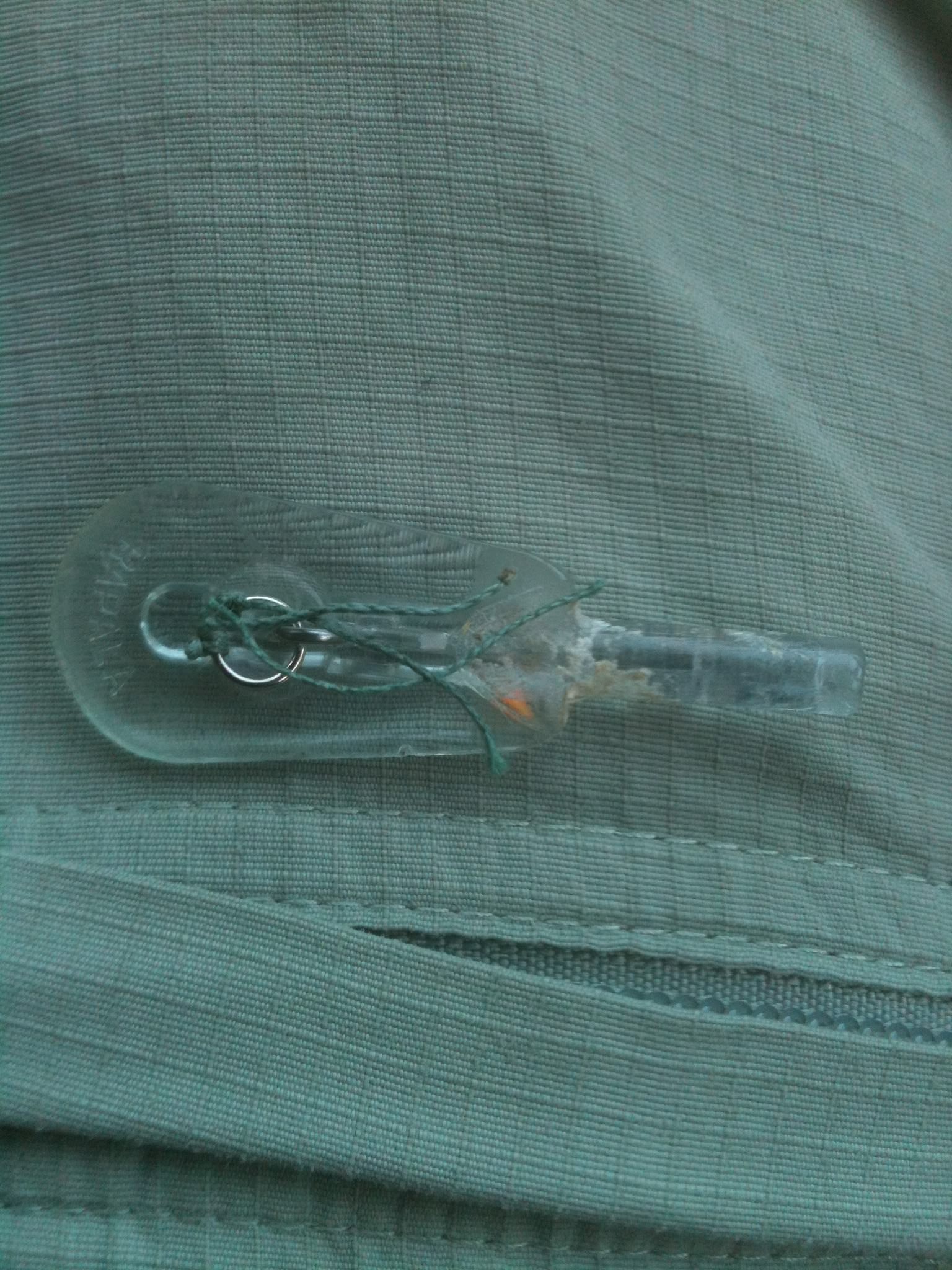
I placed fifth in that tournament. That fish that I lost would have won it. I won a gift card and when I used it I spoke with a guy named Chad Hoover for the first time. The rest, as they say, is history.
Since then, I have fished in hundreds of kayak bass tournaments. About one dozen have been on Jordan Lake. Working from memory, I recall having a bad event there with Carolina Yakfish in 2013. I also skunked at the infamous CKA event there in 2015, and had mediocre events in subsequent years, consistently finishing in the middle of the pack (or worse).
You would expect that since it is my home lake, and I know the fishery well, I would do better in tournaments on my home lake. But there are differences. Knowledge and experience don’t always apply to tournament conditions, and execution forgives no error. When you lose a big fish, it’s lost forever.
Along the way, I also learned some things. I learned that Jordan rarely gives up huge limits for kayak anglers (it only gave up a single 100” limit from 2020-2023, despite the fact that three clubs fished the lake in that time). So I have learned to tone down expectations: the anglers who win events or cash checks are the ones who find good fish on Jordan.
And they are there; in addition to landing what was then my personal best there in 2015, I have also landed my personal best in live competition there, when a 23” Largemouth bass I landed won the Big Bass pot at a CCKF tournament in 2022.
What was the key to those big catches? I caught them near the nurseries I mentioned above. The tributaries, creeks and culverts of Jordan Lake pour all kinds of stuff into the lake, and big bass know it, so they gravitate to those areas to find easy meals.
And so do the schools of fish. On a tough day, finding a school can nearly guarantee a good finish. I won a different CCKF event that was held on Jordan Lake in 2022 by catching fish from two different schools I had located. And when I placed fourth on that cruel day in 2023, I repeated the strategy. Sometimes, quantity is the key. If you focus too much on big bites on Jordan Lake, you may end up by not catching a limit. That’s what happened when I landed that 23” in 2022 – I ended the day with only two keepers.
In Conclusion
Buck Payour’s Bass Fishing (1988) book is one of the few books devoted to bass fishing in North Carolina. A collection of Paysour’s articles, it proceeds region by region, lake by lake, to review most of the major fisheries. What he says about Jordan Lake is of particular interest. For example, Buck Paysour writes about finding a good topwater bite there on a warm winter day. He also describes how he saw a bald eagle there while fishing, and it “was worth the whole trip.” For those too young to know, Bald Eagles were still in danger of extinction during the 1980’s.
Today, you can observe Bald Eagle nests from special observatories on the lake. On a good day below the dam or along the Haw River, you might see a dozen of them or more lining the trees.
One morning while fishing the rip rap along Farrington road, I paddled around a corner past the bridge. It was during the shad spawn. There was an egret standing on a rock every 2-3 feet, for over one hundred yards. I realized pretty quickly that with about fifty egrets waiting along the bank, the bass would not be biting there that morning.
The lake record bass was caught not far from that area, weighing in at well over 14 pounds. I have watched boats fish the area for years, hoping another lake record will show up on the spot. I won’t be surprised when it happens. I also won;t be surprised if it is caught from a kayak.
Jordan is both a kayak-friendly lake and a nightmare for paddleboats, I should add. It has many launches along its length, but entire sections of the lake, covering miles and miles of water, are remote and have no launches. Whether it is a smooth boat ramp or a primitive launch, the lake itself is often busy with motorboats, jet skis and even sailboats. Most paddlers do not venture too far from most ramps.
But some do. I’ve seen them as I cross a bridge over the lake. They are miles from a ramp, searching around for something. Maybe it’s peace and quiet. Maybe it’s a big bite, or a bird. Maybe it’s Big Bird.
It’s what the romantic poets called the Sublime (or some postmodern version of it). There’s terror and beauty, all at once. You fear it but keep paddling toward it.
That’s the funny thing about Jordan: you might find what you are looking for on the lake one day, as if a dream had come true. The next day you go back, and it is gone.
First published August 10, 2023. The author did not use any machine to generate written content in the composition of this article.
© Henry Veggian 2023. This material may not be copied, broadcast or re-published without written consent.
 Welcome to Bowfin Country